Baghdad, Najaf, Karbala and Erbil were the 4 destination points for Trade Promotion Council of India (TPCI) to hold BSM meetings of Indian company representatives with prominent buyers from Iraq. The event, executed by the Indian Embassy in Iraq, was also a confidence building exercise for Indian exporters, many of whom quit doing business with Iraq when the country went into turmoil post 2002. H.E. Pradeep Singh Rajpurohit, India’s Ambassador to Iraq ably assisted by Mr. Rajinder Kumar, Commercial Attache in the Indian Embassy in Iraq, orchestrated the proceedings including arranging meetings with Senior Officials, Trade bodies and Ministries. The four-day business delegation met prominent businessmen and interacted with Trade bodies in each of the four cities besides getting a chance to meet the Hon’ble Minister of Trade in the Iraqi government HE Mr. Mohammed Hashim Al Ani, in the company of Senior Officials of Ministry of Trade and of Foreign Economic Relations Department of Iraq. It was the first delegation of its type that visited Iraq since 2003. During the interactive session that followed, the Hon’ble Minister assured of his best cooperation to enhance bilateral trade between India and Iraq. The delegation comprised of more than 30 representatives from Companies dealing in various different commodities. While Chaizup Beverages LLP, Es Pee International, Swiss Singapore India Pvt. Ltd., McLeod Russel India Ltd., Team United Marketing Pvt. Ltd. and Indian Tea Association representative Sujit Patra belonged to the Tea industry, DP Chocolates, DP Cocoa Products LLP and DP Chocolates represented Confectionary Industry. Shellz Overseas Pvt. Ltd. also dealt in Confectionary besides sugar and juices. Delegation comprised of PCL Foods, Bhole Nath Foods Ltd. and Veer Overseas Ltd. dealing in Rice and Grow Global, India Global Foods Pvt. Ltd. and Agro Crop dealing primarily in Rice, Spices, Ready to Eat Food and other Grains. Shri Hari industries took Sesame Seeds and Basil Seeds to export while Indian Garden was looking for buyers dealing in fresh fruits and vegetables. During the subsequent meetings with DG-Food Stuffs Eng. Kassim H. Mansoor and with Iraqi Indian Economic Cooperation Council, Iraqi Indian Business Council and Federation of Iraqi Chamber of Commerce, certain key points related to furtherance of trade and commerce between Iraq and India were discussed. This was followed by a meeting with Mr. Bahaa Hameed Abdulridha, GM and his team at Noor Alkafeel Company in Karbala. In Najaf, the TPCI delegation got a chance to interact with Najaf Chamber of Commerce while in Erbil they had an interaction with Salahaddin Investment Company. A remarkable policy change that was discussed was that the tenders floated till date by the Grain Board of Iraq for rice were of quantity of 30000 tons which was a hindrance to small players. Moreover, the date for finalization of tender was always over one month before and with rice price fluctuating on daily basis, it was not possible to quote so much in advance. It was suggested that the timeline be reduced to the extent possible and the quantity of purchase be reduced. Eng. Kassim Mansoor took an immediate decision by assuring that the tenders would be open only a week after announcement and would consider that quantity of 30,000 tons be distributed between at least 3 players to ensure surety of supply. This first delegation visit to Iraq after 2002 thus turned out to be a very productive one. Apart from acting as a confidence building exercise between Indian sellers and Iraqi buyers, it greatly changed the perception of Iraq market and brought to focus the existing bottlenecks, including lack of direct banking and sea route as top concerns. All the 30-odd members of the delegation were greatly pleased that the Iraq trip gave them an opportunity to re-enter this emerging market of Food & Beverage. The feedback by some of the delegates from representing companies showed they found immense business opportunity in the new Iraq and were overall appreciative of TPCI and Indian embassy’s efforts to create better business opportunities for Indian companies. Present here are some of the observations: Sanjib Das, Swiss Singapore (I) Pvt Ltd. Overall good experience in Baghdad. Also got good exposure in the wholesale market in Najaf. The support from the Embassy as well as TPCI was outstanding though more tea buyers would have been welcome. Prakash Patel, Shri Hari Industries First time in my life, I had such a good experience while indulging in B2B meetings. It was an excellent experience dealing with the Kurdish people who are good. Vishal Goel, Indies Global Foods Pvt. Ltd. Got very good support from the Indian embassy especially Rajpurohit ji who was with us for the entire tour carrying Indian flag and promoting Indian business community. TPCI is putting great efforts in providing opportunities to Indian business houses. Mr. Ashok Sethi’s role is remarkable as he drives and promotes opportunities for all of us. Erbil was a great opportunity for us. We are awaiting response to the Minister of Trade’s promise that he will get us associated with right partner for business. Rakesh Kumar, Bholenath Foods Ltd. It was a good effort by the Indian Ambassador to Iraq and the TPCI team who supported us by making us meet with the big buyers from Iraq. We are sure to get business from this country. Indian foreign trade minister should advise Iraq to have a better banking system in place, like we have with Iran. Laxmikant Taunk, Chaizup Beverages Well organized and well-planned trip by TPCI and their team comprising of Mr. Ashok Sethi and Mr. Fraz Khan. Excellent support by Indian embassy and team too. I am sure I will have good business in Iraq. Shiv K Batra, Veer Overseas Ltd. Great effort put up by TPCI and the Indian embassy in organizing this trip. It was comfortable and informative trip, though hectic. Could have been better if we had stayed for two full days at each destination. Sandeep Khaitan, Team United Marketing (P) Ltd. A splendid effort by TPCI to organize the trip.


India Plans to Discuss Duty Cuts with China: Are we moving beyond RCEP?
India plans to have bilateral discussions with China on duty cuts under the Regional Comprehensive Economic Partnership (RCEP) trade agreement. However, how much we can give to China in the absence of reciprocity framework, is a challenge to work upon? The conclusion of the agreement has been pushed to next year with the crucial issues of goods, services including easier movement of professionals, and investment still being negotiated. RCEP is a mega-trade agreement, spanning across 10 ASEAN countries and its six free-trade agreement partners which includes Australia, New Zealand, Japan, China, Korea and India. China and India have enough time to decide upon the course in market access, as, still fifteen months are left to intensify the market access negotiations. India will have to allow duty cuts on more than 80% of the goods imported from China over a period of 20-years. India can, however, exclude 20% of its tariff lines, including agriculture, finished goods, automobiles and textiles from duty cuts. In 20 years, India is expected to create capacity and competitiveness. RCEP will buttress in creating markets for Make in India. For ASEAN, Japan and Korea, India will need to eliminate or reduce duties for 90% of the products. The India-China bilateral meetings could take place before the RCEP countries meet for a round of negotiations in Indonesia in February and the ministerial in Thailand in April followed by another round of talks in Australia in May. On the other hand China is expected to give higher duty concessions for India’s exports because of the trade imbalance. India’s exports to China amounted to $12.5 billion in 2017 while imports from that country stood at $72.0 billion. Policy makers complain that exports from ASEAN into India have surged far quicker than Indian exports to the bloc, which they attribute to the fact that India is a “services economy.” Thus, they’re willing to hold up RCEP until Indian companies are granted more market access for services than is currently the case. India has largely failed to develop a manufacturing sector because its factories aren’t competitive and aren’t plugged into global supply chains. Over the past few years, tariffs have started rising as well, often in an ad hoc and arbitrary manner, which means that becoming part of spread-out value chains will be even tougher. As for Indian services exports, the truth is that market access isn’t as straightforward as all that. Services trade requires harmonized rules and regulations — something that RCEP isn’t prioritizing in the first place. And, in fact, many bits of the agreement that do focus on convergence of rules, are also unacceptable to India. It will object, for example, to any clause that forbids laws mandating data localization, having already clamped down on foreign payments networks and internet companies. Given the difficulty of getting Indian negotiators to the table for bilateral trade deals, the RCEP remains the best chance to incorporate India into a genuinely open trading bloc. In the end, success will come down to give and take, and one country will have to give the most: China. India’s concerns about hidden Chinese subsidies and closed Chinese markets are shared now by much of the world. While RCEP may appear to be a multilateral deal, negotiations between China and India lie at its heart. Other countries have now accepted that fact, allowing India to also negotiate separately with China, as well as Australia and New Zealand, under a “bilateral pairing mechanism.” For Chinese economy, this is an opportunity to demonstrate not just its continuing commitment to free trade but also its willingness to make trade fairer than it’s been in the past. If the 2019 deadline is to mean anything, then both India and China will have to think very hard about where their national interests really lie. The conclusion of the RCEP agreement has been pushed to next year, though negotiations on seven chapters of the agreement have concluded, market access negotiations are in final stages. Consensus could not be reached on ecommerce, competition and investment chapters. Henceforth the mega trade agreement may look to cross its penultimate round of negotiations and has entered into its ultimate phase. Currently it looks equivocal as it is daunting to figure it out the priority route.

Shaping Agri Export Policy: What Cabinet Can Discuss?
The Union Cabinet is likely to take up agriculture export policy in the first week of December. The proposed agriculture export policy aims at doubling outbound shipments of farm products and increasing their share in the world market, The Commerce Ministry having already finalized the policy and forwarded it for the consideration by the Government. The emphasis is likely to be on all aspects of agricultural exports, including modernizing infrastructure, streamlining regulations, curtailing knee-jerk decisions, standardization of products, focusing on research and development activities, and setting up of an agency in line with the European Food Safety Authority for framing, regulating and implementing rules related to both production and trade. The proposed National Agriculture Export Policy also needs to provide an assurance that the processed agricultural products and all kinds of organic goods will not be brought under the ambit of any kind of export restriction such as imposing minimum export price, export duty and ban etc. The draft policy, prepared by the Ministry, has suggested bringing in a stable trade policy regime, reforming the APMC (Agricultural Produce Market Committee) Act, streamlining of Mandi fee, and liberalizing land leasing to double the agricultural shipments to over USD 60 billion by 2022. It has also pitched for greater participation of states, enhancement in infrastructure and logistics and research and development (R&D) activities for new product development for the upcoming markets. There has been a penchant to utilize current norms as an instrument to attain short-term goals of taming inflation, providing price support to farmers and protecting the domestic industry, given the domestic price and production volatility of certain agricultural commodities. Precise forecasting of agri production would benefit a lot and even occasional shortfall should be met through imports rather than restraining exports. Freight subsidy for value-added agri products, floriculture and horticulture would be of enormous support. India’s exports in 2017 was about USD 35 billion, which is over 2.2 per cent of the world agriculture trade. Agricultural products constitute over 10 per cent of the country’s total merchandise exports. The main commodities exported by India include tea, coffee, rice, cereals, tobacco, spices, cashew, oil meals, fruits and vegetables, marine products, meat, dairy and poultry products. However the worrying factor is that exports of value-added items is significantly low. The proposed policy advocates for adoption of a cluster based approach for agriculture commodity exports so that quality products can be exported. The clusters will now be also concentrating to produce world class products which complies with the international phytosanitary standards. What Cabinet must include? Mapping Food Product for each specific food importing economy: This will facilitate in analyzing the kind of food/agricultural produce India needs to cultivate / process to cater to the demand of individual economy. Reverse Engineering Approach: Instead of identifying the potential product which Indian region is specialized in cultivating, we need to cultivate and process such products that are required and imported by specific food importing economies, including synergy on SPS and TBT and Codex Alimentarius. In a pre-determined manner, cultivation will take place from stage 1 taking care about the exports requirement of a particular Economy / Market. Agricultural Enclaves can also be considered as part of a bigger value chain mechanism (raw materials, intermediates, finished products and marketing) where the value chain extends beyond geographically defined boundaries. ATP Agreement: There is an agreement, adopted by no less than 20 countries, titled “Agreement on the International Carriage of Perishable Foodstuffs and on the Special Equipment to be used for Such Carriage” “(ATP)”. Its purpose is to direct participants to follow common standards for the temperature-controlled equipment (road vehicles, railway wagons, containers etc.) within Europe, thereby facilitating international traffic in certain perishable foodstuffs. The Cabinet decision addressing and approving these issues is crucial for India to speed up the pace in adopting the modern practices, to be implemented in agricultural exports, to fetch the desired export figures.

Product Profile- Organic Food Products
APEDA, Ministry of Commerce and Industry defines Organic products as “the products grown under a system of agriculture, without the use of chemical fertilizers and pesticides with an environmentally and socially responsible approach”. Organic farming has several benefits beyond widely publicised reduced exposure to pesticides and other chemicals entailing food safety. The system of organic farming impacts the sustainability of agro ecosystem as a whole. It builds the fertility of soil by encouraging growth of soil based flora and fauna. It also allows for better water retention capacity of soil, immunity from diseases and sound soil management. It mitigates the effect of harmful chemicals, greenhouse gas and global warming. FAO claims that organic farming produces more biodiversity than other farming systems. India is endowed with large agricultural land and has the potential produce almost all varieties of organic products due to its diverse range of agro-climatic conditions. Infact, organic farming is a tradition in many parts of the country. As per FIBL & IFOAM Year Book 2018 India is ranked 9th in in terms of World’s Organic Agricultural land and 1st in terms of total number of organic producers. As per the APEDA database total number of operators involved in organic cultivation are over 7 thousand while the farmers engaged in organic cultivation are close to 11 lakh. Detailed distribution of the operators and farmers engaged in organic cultivation are- Individual farm producers 1918 No. ICS Groups 3488 (10.91 lakh farms) Total Processors 1081 No. Total Trader 822 No. Wild harvest Operators 79 No. Total Operators 7388 No. Total Farmers 10,93,288 Total area under organic cultivation in India in 2017-18 as per APEDA is 3.5 million hectares. Madhya Pradesh leads the list of largest area under organic certification with an area of 1.1 million hectares under certification followed by Rajasthan, Maharashtra and Uttar Pradesh. One remarkable achievement of Sikkim has been that it has been able to convert its entire cultivable land i.e. 76 thousand hectares under organic certification in 2016. APEDA database mentions that India produced around 1.70 million metric tonnes (2017-18) of certified organic products in 2017-18. Oil seeds are the single largest category in terms of total production of organic products with a production of 5.4 lakh metric tonnes followed by Sugar crops, Cereals and Millets, Fiber crops, Pulses, Medicinal, Herbal and Aromatic plants and Spices. India produced 46 thousand metric tonnes of organic Medicinal/Herbal/Aromatic Plants, 45 thousand metric tonnes of spices, 54 thousand metric tonnes of organic fruits and vegetables and 7 thousand metric tonnes of organic ornamental flowers in 2017-18. Total export of organic food products from India in 2017-18 was 4.58 lakh metric tonnes in terms of quantity and in value terms total export was worth 515.44 million USD. Top 3 export destinations of Indian organic produce are USA (export value – USD 234.6 million), European Union (export value – USD 196.8 million) and Canada (export value – USD 51.8 million). Oilseeds (47.6%) lead the list of organic product export from India with a share of 48% of total organic food products export from India. It is followed by Cereals and millets (10.4%), Plantation crop products such as Tea and Coffee (8.96%), Dry fruits (8.88%), Spices and condiments (7.76%) and others. As per Euro monitor International ‘Sresta natural bio products’ is India’s largest organic foods company followed by ‘organic India’ and ‘chamong tee exports’. It also estimates India’s organic food market size of INR 378 cr at a growth rate of 19% in 2017. India is evidently not just a major producer but also a big market of organic food products.
Country Profile- Kazakhstan
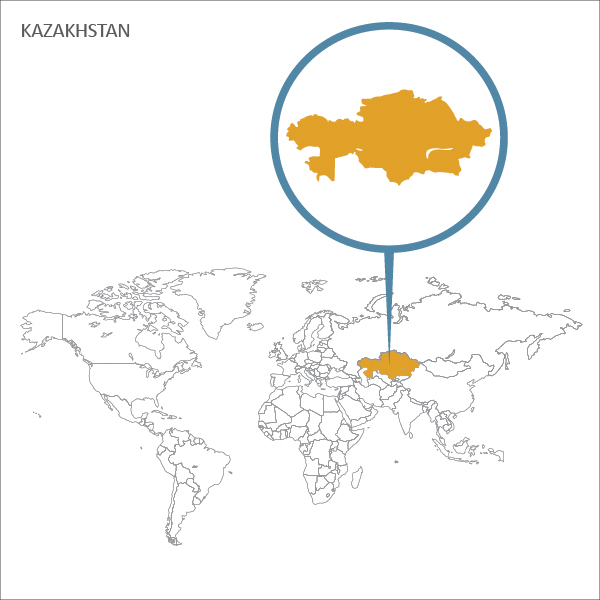
Kazakhstan is located in the Central Asia. It is the world’s largest landlocked country. The country is endowed with natural resources such as petroleum, gas, chromium, lead, zinc and uranium. The United Nations Development Programme ranks Kazakhstan 58th in terms of Human Development Index with the value of 0.800. It is ranked 28th in ‘Ease of Doing Business’ by World Bank released in 2018 with 1st rank in protecting minority investors and 4th in enforcing contracts. As per World Economic Outlook Database, 2018 estimate Kazakhstan is ranked 42nd in world in GDP in PPP terms at a value of US$ 508 billion while ranked 50th in GDP in nominal terms at a value of US$ 184 billion. The per capita GDP of Kazakhstan in PPP terms is estimated to be US$ 27494 and in nominal terms it is estimated to be US$ 9977 in 2018 by World Economic Outlook Database. TRADE STATISTICS In 2017, Kazakhstan imported US $ 29.3 billion worth of goods. Its export was over US $ 48.3 billion in value in 2017 which accounted for 0.3 % of the total exports in the world. As per ITC trade map Kazakhstan ranks 50th among the top world exporters, list is led by China. The top trading partner of Kazakhstan is Russia, followed by China and Italy. India does not rank in the list of top 10 trading partners of Kazakhstan, but has a significant import from Kazakhstan of worth US$ 1.04 billion and an export value of US$ 118 million from India to Kazakhstan, resulting into a trade deficit of US$ 921 million for India. KAZAKHSTAN’S MERCHANDISE TRADE WITH WORLD Kazakhstan’s exports to the world have followed its path of imports throughout, as can be seen in the graph below. The country has maintained a trade surplus throughout the past decade but the trade surplus is consistently declining post 2011. In 2017 it had a trade surplus of US $ 18.9 billion. In the last 10 years trade surplus was highest in the year 2011 at US$ 50.1 billion. KAZAKHSTAN’S EXPORT TO THE WORLD Kazakhstan’s total export in 2017 amounted to US $ 48.34 billion. Natural resources are the primary export products of Kazakhstan. Its top export product at HS-6 digit level last year was Crude petroleum oil, Copper cathodes, Ferro chromium, Natural gas and Natural uranium. These products constitute 71% of the total export basket of Kazakhstan. KAZAKHSTAN’S IMPORTS FROM THE WORLD Kazakhstan’s import basket is primarily led by Medicaments, Telephones for cellular networks, Medium oils, Light oils, Motor cars and other motor vehicles and Appliances for pipes, boiler shells, tanks which together make up the Top 5 imports of Kazakhstan. These products constitute 10 % of the total import basket of Kazakhstan. INDIA- KAZAKHSTAN MERCHANDISE TRADE Barring the year 2011 and 2012 India consistently maintained a trade deficit with Kazakhstan. Deficit reached the highest i.e. turned worse in 2017 with a deficit of 921 million. India’s export is following a declining trend year on year after 2013. Barring the dip in 2014 and 2015 Indian’s import from Kazakhstan followed an upward trend. INDIA’S EXPORT TO KAZAKHSTAN India’s total exports to Kazakhstan amounted to US $ 118.4 billion in 2017. Its top five exports at HS-6 digit level were Tea, Medicaments, Refractory cements, mortars, concretes, Vaccines for human medicine and Cashew nuts (Shelled). It amounts to 59.6% of the total export to Kazakhstan from India. INDIA’S IMPORT FROM KAZAKHSTAN India’s total import from Kazakhstan in 2017 was US $ 1.04 billion. India’s import was dominated by Crude Petroleum oils, Medium oils and preparations, Asbestos, Ferro-chromium and Phosphorus. The import basket of India for the products imported from Kazakhstan is highly skewed, such that the top 5 products amount to 97 % of total imports by India from Kazakhstan. India-Kazakhstan economic relationship is primarily influenced by energy resources. India is not just an important oil importer but proposed TAPI pipeline – The Turkmenistan–Afghanistan–Pakistan–India Pipeline (TAPI), also known as Trans-Afghanistan Pipeline may boost the import of natural gas by India from Kazakhstan. Besides the traditional source of energy the two nations are also collaborating on clean nuclear energy since Kazakhstan is endowed with large nuclear reserves and India is a large energy consumer. India has a civil nuclear pact with Kazakhstan for the purchase of uranium from Kazakhstan. As per UNCTAD investment report, from 2001 to 2012, Kazakhstan received US$ 200 million of FDI from India while India received US$ 29 million of FDI from Kazakhstan from 2001 to 2012. Both nations have sought to establish extensive collaboration and commerce in information technology, space research and defence technology.
Reviving and revamping the Indian SEZs
India was one of the first Asian countries to recognize the effectiveness of the Export Processing Zone (EPZ) model in promoting exports, with Asia’s first EPZ set up in Kandla in 1965. However, this first mover advantage was lost in time as China utilized the opportunity to create profitable business model while Indian Special Economic Zones (SEZs) became loss-making units having vacant lands and underperforming units, with several factors like multiplicity of controls and clearances, absence of international level infrastructure, unstable fiscal regime and lack of focus of the political class hindering their progress. For those unaware, SEZs are specifically delineated duty-free enclave and are deemed to be foreign territory for the purposes of trade operations and duties and tariffs. In other words, SEZ is a geographical region that may have economic laws different from a country’s typical economic laws. The main objective of the SEZ scheme was and remains generation of additional economic activity, promotion of exports of goods and services, promotion of investment from domestic and foreign sources, and creation of employment opportunities along with the development of infrastructure facilities. As mentioned earlier, while SEZs were set up to provide a hassle-free environment for exports and to replicate China’s success in using SEZs to boost manufacturing and employment, the policy backfired and far from turning India into a powerhouse of manufacturing exports, the control-free industrial enclaves became centres of land-grabbing and corruption. With a view to revive the Indian SEZs, the Commerce Ministry in June 2018 had set up a panel to make India’s SEZ policy more compatible with WTO rules. The panel led by Bharat Forge Chairman Baba Kalyani and having Ravindra Sannareddy, MD, Sricity SEZ Ltd; Neel Raheja, Group President, K. Raheja Group; Arun Misra, MD, Tata Steel SEZ Ltd. Anita Arjundas, MD, Mahindra Life Space Developer; Ajay Pandey, MD and Group CEO, GIFT City SEZ Ltd; Srikant Badiga, Director, Hyderabad Phoenix Developer and other government representatives was formed to suggest measures to cater to the needs of exporters and make India’s export policy more WTO friendly in the light of the US challenging India’s export subsidy program at the WTO. The group has evaluated and submitted its report in November 2018 on the SEZ policy in which it has suggested measures to cater to the needs of exporters in the present economic scenario and to make the SEZ policy WTO compatible and has also suggested course of correction in SEZ policy. The committee has recommended several measures, including continuation of tax incentives, migration of SEZs to employment and economic enclaves, and creation of link infrastructure and maintenance for enclaves. It has also suggested that the incentives should be linked with employment, investment, technology/innovation, and infrastructure status for these zones to improve access to financing. The Commerce Ministry is of opinion that the suggestions of the committee are very constructive and it plans to hold formal consultations with the finance ministry and other ministries so that the implementations of the committee’s recommendations may be done without any delay. The Union Minister for Commerce and Industry Mr. Suresh Prabhu is taking keen interest in this regard, which is an indicator towards early implementation of recommendations. It is to be recalled that in the month of March 2018, the US had challenged almost India’s entire export subsidy regime in the WTO including the merchandise exports from India scheme; export-oriented units scheme and sector specific schemes, including electronics hardware technology parks schemes; special economic zones; export promotion capital goods scheme; and a duty-free imports program for exporters. India and the WTO have engaged in consultations thereupon but the two sides have failed to resolve the matter bilaterally. India is of opinion that the country should not be singled-out just because it is growing faster, and should be given a chance to phase out export subsidies over a period of eight years, as was the case with other countries. The WTO has set up a dispute panel to give its verdict on the matter. India’s SEZ Policy was implemented from the first of April, 2000. This was followed by passing of the Special Economic Zones Act, 2005 by the Indian Parliament in the month of May 2005 and the Special Economic Zone Act was enacted after receiving the President’s assent on the twenty-third of June, 2005. It was on the tenth of February, 2006 that the SEZ Act, 2005, supported by SEZ Rules, came into effect. Ever since 2011, when the Minimum Alternate Tax or MAT was imposed on the SEZs, the commerce ministry has been consistently lobbying with the finance ministry to exempt the SEZs from this. However, the matter has been dragging and it was only consequent to the dispute with the US that the Commerce Ministry geared up to find some solution in a time-bound manner. The recommendations of the Baba Kalyani led panel are aimed at reviving and revamping the Indian SEZs and their implementation will require several concrete measures towards policy change by the various ministries concerned. Only time will tell whether the steps taken will be significant enough to take the SEZs out of their present mess or whether it will turn up to be just another brush up exercise aimed at quelling the WTO objections.

India-Viet Nam trade relations on surge
It was only in September 2018 that Prime Minister Narendra Modi had visited Viet Nam. This has been followed by the visit of President Ram Nath Kovind to Viet Nam from November 18-20, 2018. The Vietnamese Prime Minister Nguyen Xuan Phuc was the Chief Guest at India’s Republic Day celebrations in January 2018 and only a few weeks later President Quang came on a visit to India. It seldom happens that four senior-most heads of two countries visit each other within a year. But Viet Nam is an exception, feels Vietnamese newly appointed Ambassador to India Pham Sanh Chau and sees it signifying the strong emerging relations between India and Viet Nam. During his recent visit to Viet Nam, President Ram Nath Kovind and his counterpart Nguyen Phu Trong agreed to further strengthen bilateral strategic co-operation in defense and oil and gas sectors. The two leaders reiterated the importance of building a peaceful and prosperous Indo-Pacific region on the basis of respect for national sovereignty and international law. The Indian President also stressed on enhanced cooperation between the two countries in the areas of agriculture, pharmaceuticals, textiles and IT adding that agriculture has been a key sector of cooperation where India is privileged to support the Vietnamese agricultural revolution through the establishment of Cuu Long Rice Research Institute. It is to be recalled that only recently a high-level delegation headed by the Minister of Agriculture in Viet Nam had met a delegation from Trade Promotion Council of India (TPCI) to discuss ways and means to enhance bilateral trade in the field of agricultural produce. Mr. Kovind during his trip to Viet Nam reiterated the need to develop agricultural trade further stating that over 45 per cent of India-Viet Nam bilateral trade between the two countries. Agro-processing, agro-chemicals, farm machinery, bio-technology and high-tech farming hold immense potential for bilateral co-operation, the President said and added that Indian industry can learn from Vietnam’s success in crops such as coffee, pepper, cashew, fruits and vegetables. The President also said that the Indian pharmaceuticals industry, the third largest in terms of volume and the world’s largest provider of generic drugs, can partner Vietnam in providing quality health-care, medicines and medical devices for the public health system at an affordable cost. Viet Nam is a key to India’s ‘Act East’ policy. The relations between the two countries in the Indo-Pacific which includes the South China Sea assume strategic importance amidst China’s increasing assertiveness in the area. On other hand, India and Viet Nam share a vision of a rules-based order and seek peaceful resolution of disputes in the region, the President said. It is to be recalled that China claims almost all of the South China Sea. Viet Nam, the Philippines, Malaysia, Brunei and Taiwan have counterclaims over the South China Sea. “Our shared vision seeks peaceful resolution of disputes, with full respect for legal and diplomatic processes in accordance with principles of international law, including those reflected in the United Nations Convention on the Law of the Sea,” the President opined. Earlier, speaking on President Ram Nath Kovind’s visit to Viet Nam, Ambassador Pham Sanh Chau had said that the relationship between the two countries was of trust and mutual regard. This relationship is not just strategic but is based on common interests, he had said, reiterating further that the visit of Indian President will further cement this relationship. Mentioning the years of turmoil that Viet Nam has gone through, Pham Sanh Chau had said that Viet Nam “has been the battleground of superpowers. We do not want to become battleground between various powers once again. It is not our policy to align with any country against any country. We are not prepared to an alliance with any country to fight any other country. Having faced a long-drawn deceptive war in the past, our people won’t allow that to happen.” As regards to purchase of Brahmos and other military equipment from India, the Ambassador had mentioned that while he would be happy if India supplied Viet Nam’s defense requirements, but “the final decision will be with Vietnamese companies as Viet Nam adopts a model of market economy with socialist orientation.” Pham Sanh Chau was all praise for the joint exercises that have recently taken place between India and Viet Nam and stressed that Viet Nam’s preparedness was necessary for maintenance of peace, security, freedom of navigation and freedom of over-flight in South China city. Economic cooperation between India and Viet Nam has grown remarkably in recent years and there is still great potential to develop it further particularly when RCEP comes into play which will allow the two countries to further develop cooperation. RCEP however has been pushed to 2019 in the recent ASEAN summit taking place. Oil and gas too were important to Viet Nam and the country is ready to welcome all cooperation in this regard with capable Indian companies, he added. He however stressed that there were bottlenecks in export of 5 Vietnamese fruits to India and he will use his stay in New Delhi to expedite procedures for India to open market for 5 fruits and simultaneously for facilitating export of some Indian fruits to Viet Nam. On his immediate priorities, he said his first priority was to get a direct flight commenced from India. The timing of flight that was being offered by Indian authorities were not suitable to commence a flight, he said, when asked to elaborate on why there was still no direct flight despite such deep relations that the two countries enjoy. Talking on the change in leadership in Viet Nam, he said the impact of the change in leadership has been huge and very positive. “It will be a great boost towards strengthening the relationship between India and Viet Nam when President of India gets a welcome by the new leadership of Viet Nam. “We continue to give great importance and respect to our friends from India; the foundations of this relationship were laid

Reforming WTO on the focus
Ministry of Commerce and Industry is in talks with the various countries associated with World Trade Organization (WTO) to work out the way forward for reforming the organization. This initiative has been taken in view of the stress that is evident on multilateral trading system leading to surging of a number of fresh trade-restrictive measures, which affect global trade and economic growth. Suresh Prabhu, Minister of Commerce and Industry is of opinion that WTO needs to undergo the reform process to improve further. “The WTO has to change, and change for the better. We are preparing an agenda that does not exclude any country in the process of making the WTO better,” the minister said at a meeting recently. The minister claimed he has personally met 150 trade ministers to move a reformed WTO agenda forward and will keep pushing for resolution of long-pending issues such as farm subsidies and food security at the WTO but would also be open to new issues being addressed. India and a number of other developing countries are pushing for a permanent solution to the problem of food procurement subsidies to ensure that members don’t get penalized in cases where subsidies over-shoot the existing caps. These countries have been demanding that either the caps on these subsidies be removed or the method for calculating the subsidies be changed and linked to the present market prices. Some developed countries have since long been making a case for inclusion of issues such as e-commerce, investments and gender in the multilateral agenda but India has so far been opposing these attempts. India has also not been part of groups that have been formed to discuss these issues. Even the appointment of appellate body in the WTO dispute resolution mechanism is blocked, which has potential to weaken one of the central pillars of the WTO. Industry is also grappling with the sort of complementary domestic policies and global trade governance rules that would be necessary to exploit the potential benefits from technology and applications. “I am getting a positive response from all concerned, including the Director General of WTO, in our endeavour to take all counties on-board,” Mr. Prabhu said, adding further that the expansion of global trade hinges on rules and processes determined by the WTO and unless global trade expands, national economies will not benefit. It is important that all substantive issues that have been agreed to at the Doha and other trade rounds, as well as new issues that have cropped up, pertaining to the various countries’ interests and resolutions are addressed in a time-bound manner.

Global warming, if not contained, will threaten economic growth
Global temperatures are already up by about 1 degree Celcius (1.8 degree Fahrenheit) from pre-industrial level and are rising at a rate of 0.2 degree Celcius a decade. If effective measures are not taken and the temperatures rise to 2 degree level, economic growth will be hampered in many developed and developing countries, due to costs associated with floods or droughts, storm surges, salt spray damaging crops or an increase in human deaths from heat-waves. If emissions continue at their present rate, human-induced warming will exceed 1.5 degree Celcius by around 2040. The Paris climate agreement, adopted by almost 200 nations in 2015, set a goal of limiting warming to “well below” a rise of 2 degree Celcius above pre-industrial times while “pursuing efforts” for the tougher 1.5 degree goal, which if made possible, will expose about 10 million fewer people in coastal areas to risks from natural calamities. The economic loss too will be severally reduced in such an eventuality. The deal has been weakened after the US President Donald Trump decided last year to pull out and promote US fossil fuels. The voices to limiting global warming first emanated on global platform in 2009 and since then are steadily increasing. Over a hundred Small Island Developing States, Least Developing Countries and many others are most vociferous. These groups achieved a victory of sort through placing the 1.5 degree Celcius limit alongside the legally binding goal to hold global temperatures “well below 2 degree Celcius above pre-industrial levels” in the Paris Agreement earlier this year, Salient points of the Paris Agreement are as follows: The Paris Agreement builds upon the Convention and for the first time brings all nations into a common cause to undertake ambitious efforts to combat climate change and adapt to its effects, with enhanced support to assist developing countries to do so. As such, it charts a new course in the global climate effort. The Paris Agreement central aim is to strengthen the global response to the threat of climate change by keeping a global temperature rise this century well below 2 degrees Celsius above pre-industrial levels and to pursue efforts to limit the temperature increase even further to 1.5 degrees Celsius. Additionally, the agreement aims to strengthen the ability of countries to deal with the impacts of climate change. To reach these ambitious goals, appropriate financial flows, a new technology framework and an enhanced capacity building framework will be put in place, thus supporting action by developing countries and the most vulnerable countries, in line with their own national objectives. The Agreement also provides for enhanced transparency of action and support through a more robust transparency framework. The Paris Agreement requires all Parties to put forward their best efforts through nationally determined contributions (NDCs) and to strengthen these efforts in the years ahead. This includes requirements that all Parties report regularly on their emissions and on their implementation efforts. The agreement also recognises the importance of averting, minimising and addressing loss and damage associated with the adverse effects of climate change; acknowledges the need to cooperate and enhance the understanding, action and support in different areas such as early warning systems, emergency preparedness and risk insurance. Observational records show that half a degree increase in global temperature in the recent past has resulted in substantial increases in extreme weather events. Ocean systems are particularly vulnerable to climate change, and there is already clear evidence for loss and damage inflicted by climate change on ocean systems. Experts opine that the 1.5 degree Celcius goal is not out of reach, but it means that global forest cover must be rapidly expanding by the early 2030s, rather than continuing in a state of contraction. If social barriers can be overcome, such as the impact on agricultural communities, so-called “nature-based solutions”, such as reforestation, can help to limit peak warming because their scale-up can be considerably faster than the comparable transformation of energy technologies. If these steps are taken, it will provide an additional carbon sink of more than 10Gt per year by 2070. Unless significant amount of Carbon Dioxide is reduced from the atmosphere, it will be difficult to achieve this objective and the best way to do so is to plant the required number of trees. Immediate focus is necessary to look at major emitting sectors and understand what can be done – and how fast – to come up with a list of the most important things to do in the next 30 years, in a phased manner, to bend the emissions curve downwards. It is essential to move to renewable energies, such as wind, solar and hydro power in a big way. According to estimates, the surge towards renewable energies would have to be by 60 percent from 2020 levels by 2050 to stay below 1.5 degree Celcius with the condition that “primary energy from coal decreases by two-thirds”. This means that by 2050, renewable must be supplying between 49 and 67 percent of primary energy. Recent thrust by Indian Government to enhance use of renewable energies and promote alternative sources of transport like the cycle-on-rent scheme which is coming up in a big way in Delhi is meant for this purpose. A lot more need to be done though these are small steps in the right direction!

“FSSAI is creating a regulatory environment for the food sector”
A convoy of vehicles including several cyclists starts moving from Leh in the Northern corner of Jammu & Kashmir and traverses amidst snow-fall and occasional incidents of firing and stone-pelting to reach the capital Srinagar. Another similar caravan starts from Trivandrum, comes to Kanyakumari in the extreme South and moves towards Bangalore – the Karnataka capital – amidst hired drummers and at times an elephant accompanying the enthusiastic cyclists. One such leg is flagged by the Chief Minister of Jharkhand at Ranchi and travels between the most remote stretches of land and among people celebrating the famous Chhath festival. While the Yatra moving in the North East, passes through difficult terrain, on an occasion hears sound of a bomb blast in some distant place, and rushing forward to reach the next village or the next city. And the convoy that started in Panjim in Goa moves along the villages on the Western Coast of India to reach Mumbai amid great fanfare and festivity. Six such caravans are currently moving in six different regions of India, mobilizing people as they move, volunteers getting enrolled to cycle a few hundred kilometers, eating and sleeping in the restaurants and hotels on the wayside who volunteer to provide their services. All have one aim and objective: focusing on three key themes i.e. eating safe, eating healthy and eating fortified food. The ‘Eat Right India’ movement started by FSSAI (Food Safety and Standards Authority of India) is a collective effort of key stakeholders and citizens to ensure that people have access to safe and healthy diets. It is aligned with the Government’s recent focus on public health through its key programs, namely ‘Ayushman Bharat’, ‘Swachh Bharat Mission’, and ‘Poshan Abhiyaan’. These activities are being complimented by Eat Right Melas, Conventions and National Poster Competition, and an Eat Right award. Tells Pawan Kr. Agarwal – the dynamic CEO at FSSAI who is the man behind this countrywide drive to inculcate the most important messages concerning our health and well-being: “The ‘Eat Right India’ movement is a collective effort of key stakeholders and citizens to ensure that people have access to safe and healthy diets. This movement targets both the demand and supply side i.e. citizens and food businesses, under an overarching supportive policy framework to create an enabling environment.” The ‘Eat Right India’ movement employs simple, powerful and innovative messages aimed at bringing about behavioural change and initiate capacity building programs to engage and enable the citizens to not only make the right food choices but also demand safe and healthy food. This movement also focuses on nudging the food industry to follow safe food practices, reformulate their food products into healthier ones and actively promoting safe and healthy food choices. The Swasth Bharat Yatra, which involves the relay cycle-athons moving in six regions across the country are part of the overall ‘Eat Right India’ movement that FSSAI has initiated. Tells Pawan Agarwal: “This is a huge task because unlike the West where food businesses are mostly in the organized sector, with large food chains and even retail organized through superstores, Indian food sector is still fragmented where large-scale street-vending is common. Unlike in the West, where regulatory approach is around enforcement, here in many cases businesses are not even aware of safety requirements. Awareness building and capacity building therefore become extremely important part of our efforts. People’s understanding of food safety concerns is very limited. And they are not demanding safe and healthier food from the businesses. Unless they demand, why should businesses comply! Therefore, ‘Eat Right India’ movement is about creating awareness, tell the people what are the safety concerns, what food is healthy and what food should be avoided or taken in moderation, safe food, issues of food safety, issue of personal hygiene and surrounding hygiene, issues of micro-nutrient deficiencies, deficiencies of vitamins in diet and addressing them through balanced diet or fortified staples of food.” ‘Eat Right India’ though is just one part of the story. Through tireless efforts of Pawan Agarwal during the last two and a half years, FSSAI has been able to shift the paradigm from prevention of food adulteration to food safety and is now leapfrogging in creating a regulatory environment for the food sector in the country. Though food adulteration still remains a hug concern in India and the perception still remains that the conditions have deteriorated, says Agarwal, the truth is that it is not so widely prevalent and is being controlled to a large extent. “Fact of the matter is that things have improved as far as adulteration is concerned. Now the paradigm is on food safety across the value chain. If the food has not been safely processed, contaminants or toxins can come inadvertently, and the food becomes unsafe even when no adulterants are there.” “In food safety paradigm, we are creating standards and perimeters and bench marking them with global standards,” says the CEO adding that we are rapidly moving towards food safety paradigm where we work as partners of the food industry and not as policing over the food industry. This shift is rapidly happening. “Overall the big picture is that right from setting standards to enforcement machinery so that it is more objective, fair and transparent, to improving our lab systems, and also building businesses to capacity building and finally awareness building, in case of food businesses and also consumers across the country, action is being taken on all fronts to raise the standards of food safety in our country and bring them at par with world standards,” concludes Pawan Kr. Agarwal. All food related companies are now welcome to invest in India as the regulatory environment is now becoming helpful and considerate, as long as the basic regulations are being met and prescribed food safety concerns taken care of.