Aim is high but we are already on the course! India that was ranked 142 among 190 nations on the World Bank’s ease of doing business ranking in 2014 has climbed to 77th rank this year. And there seems no stopping! Prime Minister Narendra Modi has now set an ambitious target of India breaking into top 50 countries in the World Bank’s ‘Ease of Doing Business’ ranking and is aiming to nearly double the size of India’s economy to USD 5 trillion. According to him, this growth has been achieved because the policy paralysis has ended and his government was giving policy-based governance that has helped catapult the country from to the 77th position this year. In the World Bank’s annual ‘Doing Business’ 2019 report, India secured 77th position. New Zealand tops the list, followed by Singapore, Denmark and Hong Kong. The United States is placed at 8th and China ranked 46th. Neighbouring Pakistan is placed at 136. India has improved its ranking by 53 positions in the last two years and 65 places in four years since 2014. Union Minister for Commerce & Industry Suresh Prabhu too is upbeat at this development. After all, it is his ministry which has done most of the hard-work to lead India to such levels of growth. He is of view that the overall mission of the government, led by Prime Minister Narendra Modi, is public good. Speaking at a public function recently, Suresh Prabhu placed his full trust in central leadership and said he is confident that India will come in the first 50 ranks in the next fiscal. Prabhu also announced that the Government is creating ‘sub-national’ Ease of Doing Business parameters which will be measured at the district level because that is where the local industries are flourishing. “It is going to be bottom-up approach,” he said. Taking India’s economy to level of USD 5 trillion and leading India to come in the first 50 ranks in the World Bank report for next fiscal is going to be an uphill task. Talking to top industrialists including Mahindra Group Chairman Anand Mahindra, Vedanta Resources Executive Chairman Anil Agarwal, CII President Rakesh Bharti Mittal, Kotak Mahindra CEO Uday Kotak, PayTM founder Vijay Shekhar Sharma and ASSOCHAM President BK Goenka among others, the Prime Minister said the government was working on a new industrial policy to blend realities with progress. “A policy which can understand the industry… This policy will be in line with the vision of a new India,” the PM said. PM Modi also launched the Ease of Doing Business Grand Challenge with Startup India Portal as the platform. The objective of this challenge is to invite innovative ideas based on Artificial Intelligence, Internet of Things, Big Data Analytics, Block Chain Technology and other cutting-edge technologies to reform the Government processes. This announcement was made in a meeting ‘Reflections on Ease of Doing Business’ organized by Department of Industrial Policy and Promotion (DIPP) with an aim to gear up for India’s ranking to leapfrog on the ‘Doing Business’ index next year and boost the country’s investment attractiveness. The Government has also prepared a Working Group tasked to develop a roadmap towards achieving a five trillion dollar economy by 2025. The group has been constituted by the Department of Industrial Policy and Promotion in the Ministry of Commerce and Industry with participation from the government and industry. India is one of the fastest growing major economies and is currently ranked as the world’s sixth largest economy. Earlier this year, as per the World Bank figures, India pushed France into seventh place to become the world’s sixth-biggest economy. India is now eyeing to climb ahead of United Kingdom to reach the fifth spot. However, as said, it will not be an easy task to move ahead from here. The higher we reach, the tougher it becomes. The top 50 countries have most business-friendly systems and India will have to transform all government-pubic interfaces, policies and programs, and not just the 10 measured by World Bank, if it wishes to further climb the ladder. Says Ajay Srivastava, an experienced policy analyst associated with Ministry of Commerce & Industry: “The concept of replacing an existing system with a new one faces resistance at many levels. Love for incremental improvements in the existing system is the primary block. Fear of losing cost already incurred is another. To be successful, such projects must be led by a person with a technology background and proven expertise in delivering complex projects. Simultaneous focus on both the bottoms up and top down approaches will transform governance and make doing business hassle free for ordinary citizens and business alike.” Citing an example, Srivastava says: “An exporter requires permissions from many government and business agencies like Customs, DGFT, shipping companies, banks, insurance companies and inspection agencies. Time and cost go up as she has to approach each organization separately. Creating a national trade network (NTN) that enables exporters to obtain all approvals, permissions, loan sanctions et all online will reduce time and cost of exporting. This will enable lakhs of small manufacturers to export directly. Today, they rely on middlemen.” There is a momentous task ahead and combined efforts of all will enable India to reach the next goal towards its movement towards zenith.


ASEAN countries to facilitate cross-border e-commerce transactions
Economic ministers from the Association of Southeast Asian Nations (ASEAN) entered into the grouping’s first ever agreement on e-commerce to facilitate cross-border e-commerce transactions within the region. The agreement was finalized after hectic nine rounds of negotiations with the main objectives being to facilitate cross-border e-commerce transactions, to foster an environment of trust and confidence in the use of e-commerce and to broaden cooperation among ASEAN countries to further develop and intensify the use of e-commerce to drive regional economic growth. Delivering his opening remarks at the 17th ASEAN Economic Community Council meeting, trade and industry minister Chan Chun Sing said: “This agreement will help bolster the trust and confidence of ASEAN consumers in e-commerce and drive adoption. In doing so, we will enable ASEAN businesses to grow domestically, regionally and globally,” he said. The minister also referred to non-tariff barriers, including logistics and cross-border digital regulations that remain as challenges for small and medium-sized enterprises looking. He also talked of encouraging paperless trading between businesses and governments, which can generate more rapid and efficient transactions between ASEAN countries. During the meeting, the member countries committed to implementing domestic regulatory frameworks, to being transparent, to cooperating on tech, infrastructure and logistics, education, consumer protection, legal safeguards, banking, payment, transaction and trading systems and data regulation usage and flow and at the same time also showing commitment towards being technology neutral to ensure that businesses in each market are free and able to make tech choices that best fit the open market and their needs. This agreement will undoubtedly spur further growth of online sales across the region. The region has witnessed sustained economic growth and has a young, digitally-savvy population. Consequently, ASEAN countries’ internet economy is expected to hit US$ 200 billion by 2025, of which E-commerce is expected to grow to US$88 billion. Several foreign players like Amazon and Alibaba have got lured to the region seeing its great potential. At the same time, ASEAN-based companies like Singapore’s Lazada and Indonesia’s Tokopedia too have grown significantly to capture a significant market-share. The new agreement will provide access to a wider range of products to the consumers of the region. A better range will be available at more competitive prices. Moreover, this agreement is likely to spur local entrepreneurs to create new products and to venture online to access a large and more diverse market. Even small and home businesses will get a bigger market and a broader consumer base. The agreement has also put in place online dispute resolution mechanisms to facilitate e-commerce claims and consumer disputes. Marketplaces will have to come up with framework policies, tracking and tools so as to avoid abuse, fraud and fakes. This also means that trust and credibility will play an important part. Al this will help gain the consumer confidence and spur further growth of online sales across the region. Companies will eventually get more business. It is expected that the global cross-border sales will reach 627 bn by 2022. The Asia-Pacific region is expected to be the largest contributor in terms of growth.

Developing trade with Iran amidst US sanctions
India has thousands of years of historic cultural and trade relations with Iran, several centuries before the Americas were discovered. Irony of economic circumstances necessitate India and the rest of the world to listen to the dictates of one country, whose President unilaterally decides to back out of an agreement his own predecessor had signed, after hectic parleys over the Iran nuclear deal. The age-old cultural and trade links were only getting strengthened and India was seeking to boost its overall agricultural exports to Iran when the sanctions came in. This recent upsurge in bilateral trade could have impacted the agricultural exports, particularly rice and tea industry, if India had yielded to the pressure. In 2017-18, Iran was India’s largest tea export destination by value, at about $100m of bulk tea, amounting to export of 31m kg of tea. Several countries have already buckled to the pressure and even the European Union and firms, who were showing some teeth to protect trade with Iran by establishing the Special Purpose Vehicle (SPV), have been doubly warned that doing so would incur US punishment. Consequently, Brussels which was looking forward to have the SPV legally in place by November and operational early next is still in deciding phase as no country has offered to host it. But everyone is not bowing to pressure! Though Iraq has sought US approval to allow it to import Iranian gas for its power stations, Iran and Iraq are talking of raising their annual bilateral trade to $20 billion from the current $12 billion, through enhanced focus on electricity, gas, petroleum products and activities in the field of oil exploration and extraction and a better road and rail connect between the two countries. China, Russia and Turkey are already not paying any heed to the US dictate. Germany and France are pondering ways and means to set up a Euro-based trading system to continue trading with Iran while India had found a way of coming out of dollar paying system even when the earlier sanctions were imposed on Iran. It is the US’s own unilateral policies aimed at strengthening the dollar that are actually weakening it as countries try to find ways and means of moving out of the stranglehold. With a view to decrease their dependence on the dollar, India and Japan have agreed to raise the value of currency swap from the $50 billion (agreed in 2013) to $75 billion during PM Narendra Modi’s recent visit to Japan. This means India can now readily borrow up to $75 billion from Japan in exchange for rupees, signaling even lesser dependence on dollar. More and more countries are slowly realizing that they will have to move away from their dependence on dollar; a scenario that couldn’t be expected a decade back. Trade pundits are of opinion that if India stands firm, as it has done in the past, there will be enhanced scope for trade between India and Iran after the implementation of the US backed sanctions. Trade in rupee through Vostro account of UCO bank could retain the current trade and may even get a boost if India eyes the opportunity judiciously and use the trade gap to focus on exporting products that Iran requires, some of which it was importing from other countries who have not entered into a Vostro-like deal with Iran and who have fallen to the pressure to restrict their trade with Iran. Experts in the know feel it is good opportunity for India to broaden the basket of Indian exports to Iran to better utilize the Rupee funds. It is imperative that India takes this decision in its own interest for if it would not do so, Chinese firms will fill the gap. Already, Iranian markets can be seen flooded with Chinese products, which is Iran’s biggest importer of oil. Keeping these factors foremost, India’s ambassador to Iran Saurabh Kumar recently held a meeting with the head of Tehran Chamber of Commerce, Industries, Mines and Agriculture to discuss ways of continuing Iran-India trade under re-imposed US sanctions. Both sides felt that the US sanctions may present a new window of opportunity for Iran-India ties and the new focus of mechanisms to facilitate cooperation between Iran and India should now be on banking and financial cooperation. “Sanctions create many problems, but they have also created this opportunity for us to tap into neglected capabilities and capacities,” Khansari said. Saurabh Kumar presented a list of 1000 goods items that Iran had been importing from various countries and which India exports to the world. Iran can now start importing those items from India. Kumar said that based on the US exemption, India can import from Iran 300,000 barrels of crude oil per day for the next six months. Half of this money will be wired in rupees to accounts belonging to the Iranian banks in Indian banks. Iran can, in turn, purchase the essential goods such as food, medicine and humanitarian trade goods that are exempt from sanctions. The remaining half of the oil money may be exchanged into Euros or other foreign currencies for Iran to receive and transfer, the Indian ambassador said, stressing that a mechanism has to be developed for this money to be transferred out of India. The list of 1000 goods items that India presented will serve as a ready-reckoner for Iranian authorities to decide the products that they may require. India-Iran remained essential trading partners even when sanctions were imposed on Iran previously, as India exported primary edible products such as rice, meat and tea, and fairly imported crude from Iran. India needs to focus on new set of products to export to Iran, which have so far remained tyro. They include: organic and inorganic chemicals, animal feed products, perfumery and cosmetic items, pneumatic and radial tyres, optical and medical instruments, machineries for mechanical appliances, sweet corn, ready to eat packed foods, value added processed food like wafers and cookies, automated agri machines and appliances, radars, wooden

The new Vietnamese Ambassador to India presents his credentials
Ambassador Pham Sanh Chau, the newly appointed Ambassador of Vietnam to India organized a lavish reception at the Embassy of Vietnam in New Delhi after presenting his credentials to the Hon’ble President of India. Several Indian dignitaries and prominent businessmen were present in the credential ceremony that was held in the evening. A 3-member TPCI delegation led by Suresh Kumar Makhijani, Jt. Director General at TPCI welcomed the Hon’ble Ambassador on his formal appointment. He also presented the warmest greetings on behalf of the TPCI Chairman Mohit Singla. The TPCI delegation was accompanied by Aziz Haider (Director) and Sagar Bansal (Consultant). Speaking on the occasion, the Hon’ble Ambassador of Vietnam said he was proud of the fact that his country Vietnam has a Comprehensive Strategic Partnership with Vietnam and said he was committed to a stronger relationship with India. Born in Myanmar in 1961 and brought up in the Middle East, Ambassador Pham Sanh Chau spent much of his career as a diplomat in Europe. Other than being a diplomat, he is an educator with diverse international experience in multilateral affairs, cultural diplomacy, education and world heritage. He acknowledges that India is an unknown territory for him but sought the support of the distinguished guests present in the reception so as to perform more efficiently during his stay in India. Stressing on the ideals of professionalism, deliverance, capacity building and overall happiness, the Hon’ble Ambassador said these are the basic elements of performance for his staff and he will use these while dealing with the officials in India. “I am looking forward to the success of the visit of the President of India to Vietnam,” he added. The Hon’ble Ambassador also talked of the great number of similarities that exist between India and Vietnam and referred to Buddhism which originated in India but reached Vietnam about 2000 years back with such a force that today most of Vietnam follows Buddhism. As a tribute to age-long relationship between the two countries, Ambassador Pham Sanh Chau had called upon Indian artists to perform in the credential ceremony. Prominent among those present were Aftab Seth, former Indian diplomat who served as ambassador of India to Greece, Japan and Vietnam. Another guest of honour was King Ceasor Augustus Mulenga, the Hony Consul of Vietnam in Uganda, who travelled from Uganda to be present in the credential ceremony. About 50 Buddhist monks from Vietnam who are currently training in India were also present. India and Vietnam hold key positions in South Asia which is currently witnessing a rapid growth spurt with great resurgence in investor interest. The two countries have in recent past strengthened their relationship in the areas of trade and commerce as well as in their understanding of political and security issues.
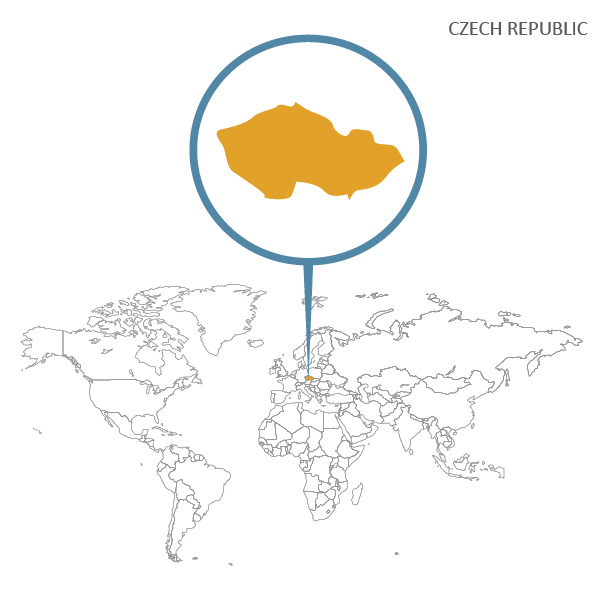
Country Profile- Czech Republic
Czech Republic is located in the Central Europe and is a landlocked country and recognised as a manufacturing powerhouse. It is an export led economy. The United Nations Development Programme ranks Czech Republic 27th in terms of Human Development Index with the value of 0.888. It is ranked 35th in ‘Ease of Doing Business report’ 2019 by World Bank with 1st rank in trading across borders. As per World Economic Outlook Database, 2018 estimate Czech Republic is ranked 50th in world in GDP in PPP terms at a value of US$ 368.7 billion while ranked 49th in GDP in nominal terms at a value of US$ 238.0 billion. The per capita GDP of Czech Republic in PPP terms is estimated to be US$ 36784 and in nominal terms it is estimated to be US$ 22468 in 2018 by World Economic Outlook Database. TRADE STATISTICS In 2017, Czech Republic imported US $162.06 billion worth of goods. Its export was over US $ 180.01 billion in value in 2017 which accounted for 1.0 % of the total exports in the world. As per ITC trade map Czech Republic ranks 28th among the top world exporters, list is led by China. The top trading partner of Czech Republic in 2017 was Germany, followed by Poland and China. India does not rank in the list of top 10 trading partners of Czech Republic, but has a significant trade with Czech Republic with an export by India to Czech Republic of US$ 393.5 million, while imports by India from Czech Republic was at US$ 630.8 million, resulting into a trade deficit of US$ 237.3 million for India. CZECH REPUBLIC’S MERCHANDISE TRADE WITH WORLD Czech Republic’s exports from the world have followed its path of imports throughout, as can be seen in the graph below. The country has maintained a trade surplus throughout the past decade. In 2017 it had a trade surplus of US $ 18.0 billion, the trade balance is positive but doesn’t follow an increasing trend. In the last 10 years trade surplus was highest in the year 2014 at US$ 21.1 billion. Barring the dip in trade surplus in 2015 trade balance of Czech Republic on an average showed an increasing trend throughout the decade. CZECH REPUBLIC’S EXPORT TO THE WORLD Czech Republic’s total export in 2017 amounted to US $180.01 billion. Its top export products at HS-6 digit level last year were Motor cars and its parts under different heads of HS code 87, automatic data-processing machines and telephones for cellular networks. More than 21% of Czech Republic’s total export is motor vehicle, cars and related parts, making it one of the biggest exporter of the same. CZECH REPUBLIC’S IMPORTS FROM THE WORLD Czech Republic’s import basket is primarily led by Telephones for cellular networks Crude petroleum oil, Data-processing machines, Medicaments and Electronic integrated circuits which together made up the Top 5 imports of Czech Republic.(Total imports – US $ 162.06 billion) at HS-6 digit level. INDIA- CZECH REPUBLIC MERCHANDISE TRADE India’s trade balance with Czech Republic in the past decade may be divided into 3 phases – pre 2016, 2016 and post 2016. Till 2015, trade balance was negative i.e. there was a huge trade deficit till 2015 for India vis a vis Czech Republic. In this phase it primarily saw an (negative) upward trend till 2011 reaching a deficit of US$ 462.0 million, declining since then, till 2015. In 2016, India had a trade surplus with Czech Republic of US$ 4.8 million. Again in 2017 trade deficit plummeted to US$ 237.2 million for India vis a vis Czech Republic. India’s export and import followed a ‘scissor’ shaped trend year on year in the last decade conjoining in the year 2016. INDIA’S EXPORT TO CZECH REPUBLIC India’s total exports to Czech Republic amounted to US $ 393.5 million in 2017. Its top five exports at HS-6 digit level were Medicaments, Cast articles of iron or steel, Engines and motors, Parts and accessories for tractors and Men’s or boys’ shirts of cotton. It amounts to 29% of the total export to Czech Republic from India. INDIA’S IMPORT FROM CZECH REPUBLIC India’s total import from Czech Republic in 2017 was US $ 630.8 million. India’s import was dominated by Gear boxes and parts, Parts and accessories for tractors and motor vehicles, Spark-ignition reciprocating piston engine, Parts and accessories of machines for sizing man-made textile and Drive-axles. The top 5 products amount to 22% of total imports by India from Czech Republic. Czech Republic is an important trading partner of India in Europe especially for manufacturing products. During the last visit by the Indian President, he himself iterated that Czech strengths in manufacturing and advanced technology make the country a natural fit to partner Indian economic growth and next-generation development. Czech Republic ranks 64th among foreign investors in India. Cumulative FDI inflows from Czech Republic stood at US $ 24.45 million between April 2000 to March 2017. Czech Republic is among the few European Economies that have registered a high economic growth rate. It is a preferred destination for Indian investors looking for opportunities in Europe. Bata, the most popular footwear company in India has its roots in Czech Republic. Czech Republic is renowned for its high-tolerance machinery and related manufacturing as well as engineering and technical skills in manufacturing. Czech Republic’s technology and engineering prowess may boost India’s “Make in India” initiative and ascertain its movement up the value chain. Czech Republic and India has moved further and have initiated engagement in exploring opportunities in sectors such as civil aviation, civil nuclear energy and solar energy. It is a step in the right direction.

Product Profile: Tea
Tea has been a very important part of the Indian culture. But there is no concrete documentation of the history of tea drinking in the Indian subcontinent for the pre-colonial period. It may have been mentioned in the ancient texts using a different referential name. It is speculated that tea leaves were widely used in the ancient India since the plant is native to some parts of India and many tribes claim to be using it for ages. Tea is credited to be originated in southwest China. Initially it was taken as a medicinal drink, later it got popularised as a recreational drink. India is one of the largest tea producers in the world. As per the Statista consumer market outlook 2018, the average per capita consumption of tea in India stood at 0.7kg making it one of the biggest per capita tea consumer in the world. As per the Tea Board of India statistics, total tea production in India stood at 1321.76 million Kgs in 2017 of which north India contributed 1087.11 million Kgs and 234.65 million Kgs was produced in south India. The bulk of India’s tea production is CTC (crush, tea, curl), at 90%, while orthodox (whole leaf) accounts for 8.4%. The rest comes from green tea. Tea plantations in India are mainly located in hilly areas of North-eastern and Southern States. The major tea-producing states in India are: Assam, West Bengal, Tamil Nadu, Kerala, Tripura, Arunachal Pradesh, Himachal Pradesh, Karnataka, Sikkim, Nagaland, Uttarakhand, Manipur, Mizoram, Meghalaya, Bihar, and Orissa. Tea production facilitation, certification, exportation, database and all the other facets of the tea trade in India is controlled by the Tea Board of India. All types of tea plants are categorised scientifically under one plant named Camellia Sinensis. The differences between teas arise from processing (majorly), growing conditions, and geography. In common parlance, tea is classified in broadly 2 categories – green and black. However based on the processing tea may be classified as – Colour after Processing Wilting Oxidisation White Yes No Yellow No No Green No No Oolong Yes Partial Black Yes Yes Dark/Puer – India’s Tea Trade Overview India is a net tea exporter. India’s total tea export stood at US$ 769 million while import stood at US $ 39.5 million in 2017. The top 5 countries to which India exports are- Top 5 countries from which India imports are- The trade data of tea can be categorised as black and green tea. More than 97% of the tea export from India is for black tea. Category wise tea trade statistics is- India’s green tea export was valued at US$ 18.8 million and black tea export was valued at US$ 750.2 million in 2017. Major importers of green tea from India are Germany, USA, UAE, Australia, United Kingdom and the Netherlands. Major importers of black fermented tea from India are Iran, Russia, USA, UAE, Kazakhstan, United Kingdom and Germany. India also imported US$ 39.5 million of tea in 2017 of which 35.7 was black tea and 3.7 was green tea. Major exporters of green tea to India are China, Indonesia, Vietnam and Germany. Major exporters of black tea to India are Kenya, Nepal, Vietnam, Argentina and Iran. Tea is the most consumed, one of the cheapest beverage among all the beverages available in the Indian market. Tea industry provides direct employment to more than a million workers and over a million are engaged in the tea industry indirectly. Most popular and widely recognised tea varieties produced in India are- Assam tea, Darjeeling tea, Nilgiri tea and Kangra tea. India commands premium in the world tea market for the mentioned tea varieties. India’s low production of orthodox variety of tea which is the preferred type pose a serious challenge to the industry apart from rising production cost. Tea is also losing out to other beverages such as coffee. But renewed focus on growing the market apart from incentives led push to the industry to move up the value chain may ensure its healthy future.

Is India a high tariff economy?
India is widely known as a country with high import tariffs. This view, however, may look fallacious. Changing this view is important for several reasons, both within India and outside. World Trade Organization estimates of India’s applied most favoured nation (MFN) tariffs, i.e. tariffs applicable in general, are 13.4% (simple average) and 7% (trade-weighted average). The World Bank reports that India’s applied average tariffs were 6.3%, significantly higher than those for low tariff economies. The corresponding estimates are 1.8% for both Australia and Chile, and 1.6% for the United States. This apparent difference between these countries and India, however, may look inaccurate. A simple way to evaluate India’s trade-weighted applied tariffs is to incorporate the percentage ratio of customs revenue to imports. The usual estimates using this method for India have ranged between 6.3% and 8.4% for the past three years, close to the applied or trade-weighted average tariffs calculated by the World Bank and the WTO. However, the actual estimate of applied tariff is provided not by total customs revenue, which for India includes a refundable component imposed on imports in lieu of the domestic excise tax. The correct basis is the “total basic customs revenue” which shows revenues from tariffs without any other extraneous revenue item added to it. Estimates using basic customs revenue show that the applied average tariff of India in the last three years ranged between 1.7% and 2.3%, similar to the average tariff estimates for economies considered relatively open in terms of tariffs. Thus, it could be articulated that India too is a low tariff economy. The large difference between India’s actual average tariffs and its MFN trade-weighted applied average tariffs arises inter alia due to the several exemptions and concessions that the country provides on its MFN tariffs. Despite these concessions, people in general continue to think of India as a high tariff economy. This suggests a need as well as a possibility for tariff policy reform to simplify and bring transparency in the tariff regime, and enable users to more easily understand the actual tariff paid. These changes would help investors and others at home and abroad, including investment initiatives under programmes such as “Make in India”. An imperative point we still need to address is that since higher tariffs disincentives imports, the trade-weighted average is inherently downward biased. It is argued that if the prevailing high tariffs are reduced, then the increase in imports would raise the average trade-weighted tariff. Let us elaborate this aspect for India. For that, we first need to separately consider agriculture and non-agriculture products. Trade policy for agriculture is always treated differently across most countries. For example, even for the United States, the 10 agriculture categories according to the WTO have maximum tariffs ranging between 18% and 350%. Maximum tariffs for four of these categories are above 130%, and between 44% and 55% for most others. The situation with non-agriculture tariffs is different, and even in trade negotiations, greater focus on market opening is given to non-agriculture products. Many of India’s bound tariff rates on agricultural products are among the highest in the world, ranging from 100 percent to 300 percent. While many Indian applied tariff rates are lower (averaging 32.7 percent on agricultural goods), they still present a significant barrier to trade in agricultural goods and processed foods (e.g., potatoes, apples, grapes, canned peaches, chocolate, cookies, and frozen French fries and other prepared foods used in quick-service restaurants). The large gap between bound and applied tariff rates in the agriculture sector allows India to use tariff policy to make frequent adjustments to the level of protection provided to domestic producers, creating uncertainty for importers and exporters. Thus, the high tariffs on agriculture is a mulling matter, but this area is treated differently in trade policy and negotiations as mentioned. Anyways, the above-mentioned low average tariffs of 1.7% to 2.3% include all products, agriculture and non-agriculture. A perception of India as a low tariff economy would prepare a basis for domestic tariff policy reform and will benefit in changing the perspective of Indian trade negotiators in their interaction with other nations. This could also provide them a healthier basis to develop negotiating strategies for seeking greater market access for Indian exports to markets abroad. Moreover, policy makers will have more flexibility than erstwhile considered feasible to evolve a revised tariff policy. Further, if tariff policy has to be combined with new industrial policy, as is now a tendency in various economies, it is better to do so with transparent tariffs that fit into a consistent policy outlook.

Why USA has ameliorated Indian oil import scenario?
The Trump administration has granted exemptions to eight countries, including Japan, India and South Korea, to continue importing Iranian oil since they have made significant reductions in oil imports from Iran. USA has said that countries like India will be further asked to bring down oil imports from Iran to zero in six months. Countries that get waivers under the revived sanctions must pay for the oil into escrow accounts in their local currency. That means the money won’t directly go to Iran, which can only use it to buy food, medicine or other non-sanctioned goods from its crude customers. The administration sees those accounts as an important way of limiting Iranian revenue and further constraining its economy. Now the question arises is whether bypassing the sanctions from Iranian and Indian side has more weight or gifting soft policies by allowing eight economies to continue trade with Iran has more weight? For USA trade relations with major economies in 2018 so far has not been mollified mainly with China as there had been continuous retaliations in terms of increasing importing tariff rates. Can we say that by allowing eight significant economies including India to continue trade with Iran for a limited time, USA want to gain some favour? Let’s try to explore the scenario. Oil is Iran’s main source of income and is also the third-largest producer among the Organization of the Petroleum Exporting Countries (OPEC). In 2018, so far Iran exported about 2.7 million barrels per day. Through its sustained pressure, the US has managed to reduce Iran’s oil exports from 2.7 million to 1.6 million barrels a month, according to internal US estimates. The sanctions also come at a time when Iran is already in the grip of an economic crisis. The rial now trades at 145,000 to $1, compared with 40,500 to $1 a year ago. The economic chaos prompted mass anti-government protests at the end of last year that resulted in nearly 5,000 reported arrests and at least 25 people being killed. In addition, the Brussels-based Swift network for making international payments is expected to cut off links with targeted Iranian institutions, isolating Iran from the international financial system. The measures will mainly affect Iranian companies in direct business with other foreign firms. Saudi Arabia, the leading player of the OPEC committee, has said that it would fill in for the lost supply. India, which is the second biggest buyer of Iranian oil after China, is being pushed by the US to restrict its monthly purchase to 1.25 million tonnes per month or 15 million tonnes a year (300,000 barrels per day), down from 22.6 million tonnes (452,000 barrels per day) bought in 2017-18 financial year. At present India has pushed back on zero oil imports citing the adverse impact on its economy and the inflationary impact it would have. The European Union, France, Germany and Britain said in a joint statement that they regretted the US decision and would seek to protect European companies doing legitimate business with Tehran. On the other hand, China denounced the new US sanctions as long-arm jurisdiction and promised to continue its bilateral trade with the Islamic republic. Beyond Crude Oil Trade The payment system with Iran is being relaxed further for basmati rice exports. This comes after the US allowed India to continue importing crude oil from Iran and develop the Chabahar port. India is now finalizing guidelines for exporting basmati rice to its largest importer Iran, on a rupee payment basis. The move has come as a positive development for exporters who are paying a higher price for procuring basmati. Last year, India exported $4.17 billion worth of basmati rice and Iran was the largest buyer (at $905 million). In the first five months of 2018-19, exports have already crossed $2 billion and Iran continuous to be the largest buyer for India followed by Saudi Arabia. When the US announced sanctions against Iran, farmers had already increased area under basmati but exporters were cautious. However, the recent exemption for Iran followed by easing of the payment crisis has lifted the sentiments of basmati exporters. Iran normally opens its market for basmati import by mid-November after taking into account its domestic production and demand matrices. India is also bullish about the prospects of the Chinese market, although it basically imports non-basmati rice varieties now. Recently, a buyer-seller meet was organized in China, where five-six Indian rice exporters had participated even as the country approved 24 domestic rice millers. However, the Chinese basmati market would still take some years before it ‘matures’ for domestic exporters. China is the world’s largest producer and importer of rice and procures about 5 MT every year. India has estimated a potential sale of one MT of rice to China. The country planned to boost rice and sugar exports to narrow the trade gap with China. Recently, five new rice mills were cleared for exporting non-basmati rice to China, taking the total to 24 rice mills. In May 2018, Chinese officials had inspected rice mills capable of exporting non-basmati rice. Meanwhile, basmati exporters have also been exploring other markets like the US, European Union and Latin America. Yet, the results have not been encouraging. West Asia, China and Iran may be big importers. As a result of high export demand and lower-than-expected crop the market is bullish. It appears that US’s pressure won’t exacerbate India’s import of oil as USA is not in its best position in terms of controlling or influencing trade directions.
Will rice help bridge the widening trade deficit with China?
India has a huge trade deficit with China and this gap is rising with every successive year. In order to bridge this widening trade deficit, New Delhi has been pitching for market access for a variety of its goods to China, including non-basmati rice, sugar, rice and pharmaceuticals. The General Administration of Customs of Chinese government and India’s Department of Agriculture, Cooperation and Farmers Welfare signed a protocol on phyto-sanitary requirements for exporting rice from India to China in June 2018 during Prime Minister Narendra Modi’s visit to China. This amended the 2006 protocol on phyto-sanitary requirements for exporting rice from India to China to include the export of non-basmati varieties of rice from India. Consequent to this, the first consignment of Indian non-Basmati rice was shipped to China towards the end of September 2018 which included 100 tonnes of non-Basmati (white rice 5% broken) sent from Nagpur in India and received by China National Cereals, Oils and Foodstuffs Corporation (COFCO) which is one of China’s state-owned food processing holding companies. Initially, Ministry of Commerce and Industry registered 19 rice mills and processing units for export of non-basmati rice after officials from China had inspected the rice mills that are capable of exporting non-basmati rice to China. Few days back, five more rice mills have been cleared for exporting non-basmati rice to China, taking the total to 24 rice mills. China is the world’s largest producer and importer of rice and buys more than 5MT a year. India is the top exporter of rice in the world with total rice exports in the last fiscal year being 12.7 MT, an increase from 10.8 MT in the previous year. There is potential to export up to 1 MT of rice to China. This, if happens, will help reduce the fiscal deficit in trade between the two countries. In our previous issue of TPCI Newsletter, we had mentioned of China lifting the ban on import of rapeseed meal from India. India was exporting US$161 million worth of rapeseed to China till 2011 when the ban was put in place. India has 500,000 tonnes of rapeseed meal surplus which can be exported to China. This waver on ban came into effect as a consequence of the US-China tariff war, as part of which China had imposed tariffs of 25% on a list of American products including rapeseed meal and soybean meal. India is also looking forward to export agriculture products like rice and sugar and pharmaceutical products to China in order to bridge widening trade deficit.
Dollar : Rise, Hegemony and Fall
India found a way of coming out of dollar payment and paying Iran in rupees for the oil it bought when sanctions were enforced on Iran prior to the signing of the Joint Comprehensive Plan of Action, known commonly as the Iran nuclear deal or Iran deal, signed between Iran and the P5+1 countries in Vienna on July 14, 2015. As the sanctions hit Iran once again from November 4, 2018, this time only at the behest of the US, India may once again pay Iran in rupees for the oil it buys from its third largest supplier. This time round it is not just India that will be opting out of using dollar as the preferred mode of payment, but many countries have started settling trade transactions in local currencies so as to reduce their dependence on the US dollar. Germany and France are setting up a Euro-based trading system to continue trading with Iran in the wake of the US call to punish countries having any trade relation with Iran while Turkey, Russia and China too have started looking at a future without the dollar and BRICS countries are talking of using their respective currencies for trading between each other. Pursuing the same line and with a view to decrease their dependence on the dollar, India and Japan agreed to raise the value of currency swap from the $50 billion (agreed in 2013) to $75 billion during Prime Minister Narendra Modi’s recent visit to Japan. This means India can now readily borrow up to $75 billion from Japan in exchange for rupees, signaling even lesser dependence on dollar. More and more countries are slowly realizing that they will have to move away from their dependence on dollar. Such a scenario couldn’t have been expected till the beginning of this decade! If we look at the dollar’s rise, hegemony and downslide, we find it has taken only a little over a 100 years to go through all this. Dollar’s birth goes back to 1914 when the first of the currency note was printed upon the creation of the Federal Reserve Bank. Within next five to six decades, particularly due to two back-to-back wars that Europe underwent, the dollar gradually rose to officially become the world’s reserve currency. Another five to six decades later, countries across the world have begun to look for avenues to come out of their dependence on the dollar. When the Federal Reserve Bank was created in 1913, it was Britain that was the centre of world commerce with much of the transactions taking place in British pound. In order to create stability in currency exchanges, most countries then pegged their currencies to gold. But with World War I breaking out in 1914, many European countries were forced to abandon the gold standard to move to paper money. This step greatly devalued their currencies resulting in the US dollar gaining world centre-stage. As a result, the US became the chief lender for many countries that were left with no choice but to buy dollar-denominated US bonds. Slowly but surely, the dollar replaced the pound as the world’s leading reserve after Britain was forced to abandon the gold standard in 1931, leading to a sharp devaluation in sterling. Though this helped the UK recover from the great financial crisis of 1931, this step contributed immensely to the dollar’s ascent to greater heights. The US was again at an advantageous position when World War II started. The Allies had nowhere else to look to but towards the US to meet their requirements of weapons, supplies and other goods. The US collected its payments in gold and by the time the war ended, it owned the vast majority of the world’s gold. Dollar’s ascendancy reached its peak when, in 1944, delegates from 44 Allied countries met in Bretton Wood, New Hampshire, and concluded that the world’s currencies couldn’t be linked to gold as most countries had exhausted their gold reserves to the US’s advantage. They agreed on linking their currencies to the US dollar, which was to remain linked to gold. Known as the Bretton Woods Agreement, the participating countries agreed that the central banks would maintain fixed exchange rates between their currencies and the dollar and, in return, the US would redeem dollars for gold on demand. Thus the US dollar became the world’s reserve currency, signaling the final ascent of dollar to its peak. Instead of gold reserves, other countries started accumulating reserves of US dollars. And to store their dollars at a safe place, they started buying the US Treasury securities. But this trend was short-lived! As the US began to flood the market with paper money, several countries including France got concerned and began to convert dollar reserves into gold.As this trend caught up, President Nixon of the US had to intervene and delink the dollar from gold – an action that led to the new trend of floating exchange rates, as it exists today. During the periods of its hegemony and continuing till today, the US Treasury securities remained the safest store of money because of the trust and confidence that the world had in the ability of the US to pay its debts. This confidence remained despite unbridled printing of paper money by the US, its large deficit spending and huge foreign debt. Dollar’s ascent was complete when the US was able to persuade the oil producing countries in the Middle East to trade oil and gas only in the US dollar. The US Dollars surge was now complete! With time, various commodities became so much dependent on the US dollar that there emerged an inverse relation between the value of the US dollar and the commodity prices. Even in case of oil, a stronger dollar makes oil more expensive to the world and oil prices tend to fall as the dollar rises. The Federal Bank’s actions began affecting the economy of all the countries of the world. If the Bank increased